Introduction
On February 10, 2026, ByteDance Seed team officially released Seedance 2.0. Unlike prior generations and competitors, it is not a stitched pipeline of «video generation + audio post-processing,» but a unified multimodal audio-video joint generation architecture designed from the ground up.
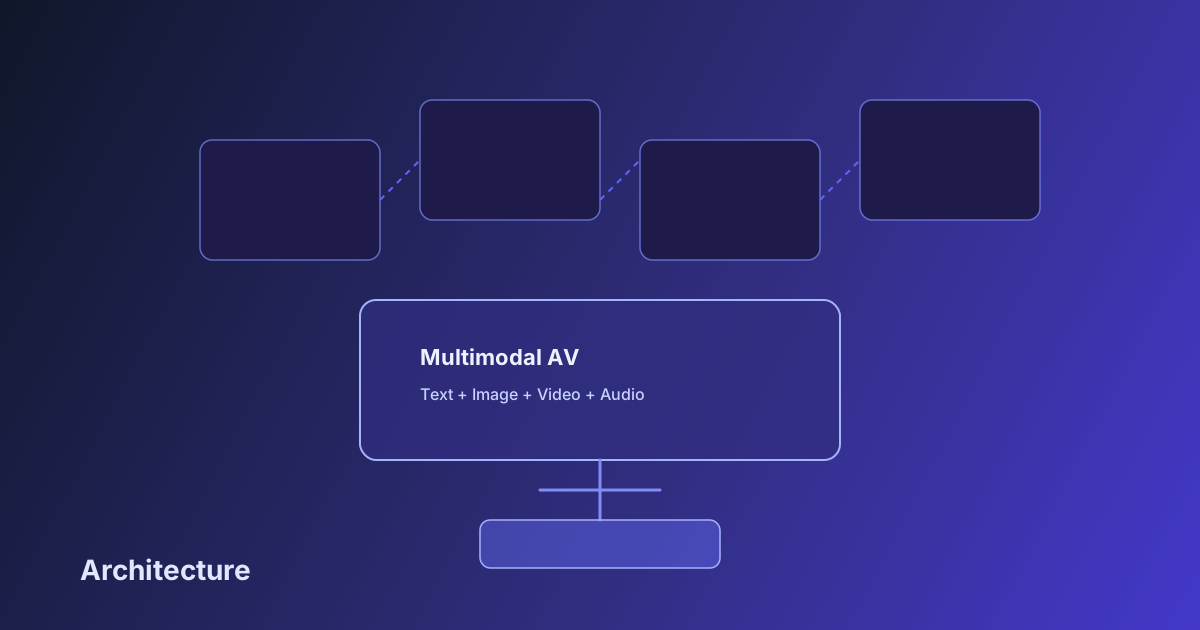
Core Architecture: Unified Multimodal AV Generation
Traditional AI video pipelines typically:
- Text/image → video frames
- Frames → audio (or external TTS/music)
- Post alignment and compositing
Seedance 2.0 unifies all three in one end-to-end model, achieving native audio-visual synchronized generation.
Multimodal Encoder
A unified encoder maps text, image, video, and audio into one semantic space:
- Text: Natural language instruction encoding
- Image: Visual features (up to 9 images)
- Video: Temporal visual + camera motion features (up to 3 clips)
- Audio: Spectral + rhythm + semantic features (up to 3 tracks)
Joint Decoder
Decoding generates video frames and audio waveforms simultaneously with shared intermediate representations, ensuring:
- Precise lip sync with speech (8+ languages)
- Action synchronized with sound (footsteps, impacts)
- Shot changes coordinated with music rhythm
Key Breakthroughs
1. Long-Horizon Consistency
Across 15-second multishot output, character appearance, scene elements, and lighting style stay highly consistent—thanks to improved temporal attention and cross-shot consistency loss.
2. Director-Level Instruction Following
The model understands complex instructions much better, supporting:
- Multi-shot script-style descriptions
- Precise camera terminology (push, pull, pan, tilt, track, crane)
- Timeline event orchestration
3. Physical Realism
In multi-person sports, fluids, cloth, and similar scenes, Seedance 2.0 approaches real-world physics.
Benchmark Performance
On Artificial Analysis Video Arena:
- Elo score: 1269 (#1 worldwide)
- Ahead of: Google Veo 3, OpenAI Sora 2, Runway Gen-4.5
- Strengths: AV sync, instruction following, long-horizon consistency
Outlook
Seedance 2.0 marks a shift from «clip generation» to «complete audiovisual works.» Future iterations may bring longer duration, higher resolution, and stronger editing.